

Xenesthis
Family Theraphosidae · Subfamily Theraphosinae · Neotropical (northern South America)
Systematic placement and authorship
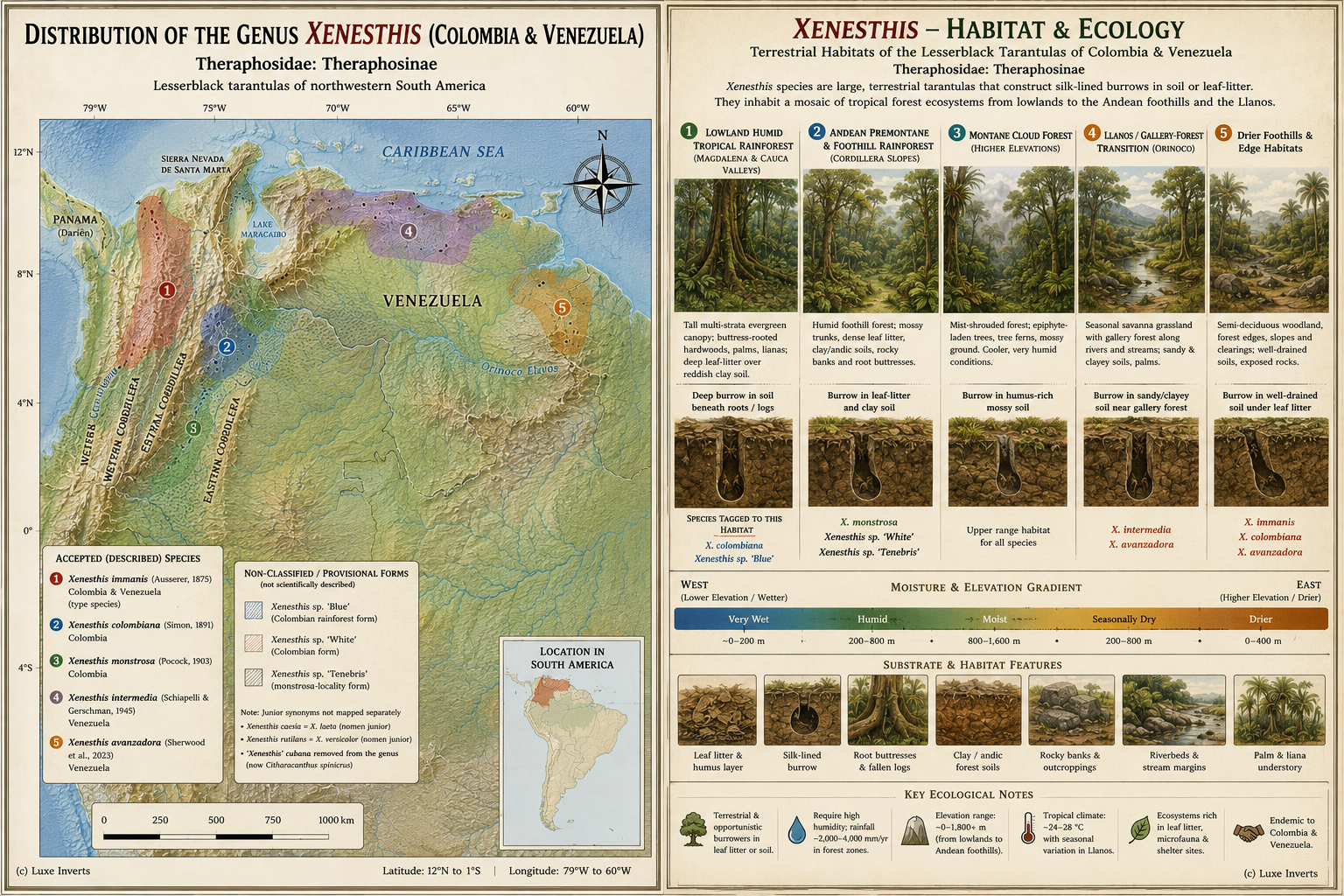
Xenesthis is a Neotropical genus of large mygalomorph spiders in the family Theraphosidae (Thorell, 1869), subfamily Theraphosinae. It was erected by Eugène Simon in 1891, with Xenesthis colombiana Simon, 1891 as the type species; the genus name is treated as feminine in gender. As a theraphosine it belongs to the large New World “ground” tarantula radiation characterized by the possession of urticating setae and by the male and female genitalic features (palpal-bulb keels, spermathecae) used to diagnose the subfamily.
Diagnosis and position
Xenesthis is grouped with the other giant, robust Andean–Amazonian theraphosines (e.g., Pamphobeteus, Megaphobema, Theraphosa), from which it is separated chiefly on male palpal-bulb and female spermathecal morphology as treated in the modern literature (Bertani, 2001; Sherwood et al., 2023). It is not a large genus, and its boundaries have historically been blurred by old synonymies and misidentifications rather than by an oversupply of names.
Current species and recent taxonomy
The World Spider Catalog (NMBE, Bern, 2026) recognizes five valid species: X. colombiana Simon, 1891 (type; Colombia); X. immanis (Ausserer, 1875) (Colombia, Venezuela); X. intermedia Schiapelli & Gerschman, 1945 (Venezuela); X. monstrosa Pocock, 1903 (Colombia, with the type locality flagged as uncertain in the catalog); and X. avanzadora Sherwood, Gabriel, Peñaherrera-R., Brescovit & Lucas, 2023 (Venezuela).
The genus’s recent history turns on two papers. X. immanis was originally described as Lasiodora immanis Ausserer, 1875 and transferred to Xenesthis by Pocock (1901), who at the same time sank X. colombiana into immanis; Gabriel & Sherwood (2022) rejected that synonymy and restored colombiana as a distinct, valid species. The following year Sherwood, Gabriel, Peñaherrera-R., Brescovit & Lucas (2023, Taxonomy 3(4): 29) revised the genus, redescribed the existing species, and described X. avanzadora from Venezuela. One further name, X. cubana Franganillo, 1930, was long ago removed from the genus to Citharacanthus.
Distribution and habitat
As catalogued, Xenesthis is a northern-South-American genus restricted to Colombia and Venezuela. Its species are animals of humid lowland and submontane forest, where they shelter at the bases of large trees, among buttress roots and root systems, and beneath fallen logs and dense litter. They are terrestrial and burrow opportunistically, lining a retreat with silk rather than excavating the deep obligate tunnels of some other theraphosines, and they tend to be more reclusive and burrow-bound than surface-active genera such as Acanthoscurria.
Size, coloration, and defense
Xenesthis contains some of the bulkier theraphosids by leg span, with mature individuals commonly reaching roughly 18–20 cm (around 7–9 in). The genus is renowned for striking sexual dichromatism: mature males of X. immanis and X. intermedia develop intense metallic violet, magenta, or carmine structural coloration over the body and legs — among the most spectacular male phenotypes documented in the family — while females are comparatively cryptic in chestnut-to-mahogany tones over a dark ground, often with a pale carapace “starburst.” As New World theraphosines they bear urticating setae on the dorsal opisthosoma and flick them defensively; the precise typology in Xenesthis follows the theraphosine pattern of type I plus type III/IV setae described in the modern setae literature (Bertani, 2001; the 2019 PLOS One revision of urticating-setae typology). Venom is of low medical significance, but the animals are large enough that a defensive bite can cause meaningful mechanical puncture and local pain, and the typical defensive sequence is hair-flicking, retreat into the burrow, and a high threat posture with a bite reserved for when the animal is cornered.
The frog association — with an important caveat
Xenesthis is widely cited for a commensal relationship with tiny microhylid frogs (Chiasmocleis), which shelter unharmed inside the spider’s burrow; the frog gains a humid, predator-guarded refuge and feeds on insects drawn to the spider’s prey remains, while the spider tolerates the frog but attacks other anurans. This is the famous “odd couple” reported by Cocroft & Hambler (1989) for Chiasmocleis ventrimaculata and a burrowing theraphosid identified as Xenesthis immanis in southeastern Peru. Two cautions are worth flagging: the catalogued range of Xenesthis does not include Peru, and subsequent commentary has questioned the spider’s identity, suggesting the Peruvian “Xenesthis” may actually be a Pamphobeteus or related genus. The frog–tarantula commensalism is real and well studied, but its firm attribution to Xenesthis specifically rests on an old identification that may not hold.
Conservation and captivity
No Xenesthis species is listed on CITES, and none has a published species-level IUCN Red List assessment; the practical concerns are collection for the international pet trade (driven by the spectacular males) and loss of humid lowland forest within a naturally restricted Colombian–Venezuelan range. In captivity the genus is kept warm and humid with deep, moist substrate, heavy refuge structure, and good ventilation, reflecting its humid-forest origins. Growth is moderate and females are long-lived, with captive lifespans frequently exceeding 15 years.
General caveat
Like much giant-theraphosine taxonomy, Xenesthis rests on a small specimen base, several historically confused names, and a recent burst of revisionary work (Gabriel & Sherwood, 2022; Sherwood et al., 2023); a molecular phylogeny rigorously testing the genus and its limits against neighboring giants has not yet been published, so the current five-species concept is morphology- and catalog-based and may change.
Sources
Sherwood, Gabriel, Peñaherrera-R., Brescovit & Lucas (2023), Taxonomy 3(4): 29 — MDPI
Cocroft & Hambler (1989), commensalism of Chiasmocleis ventrimaculata and Xenesthis immanis — ResearchGate record
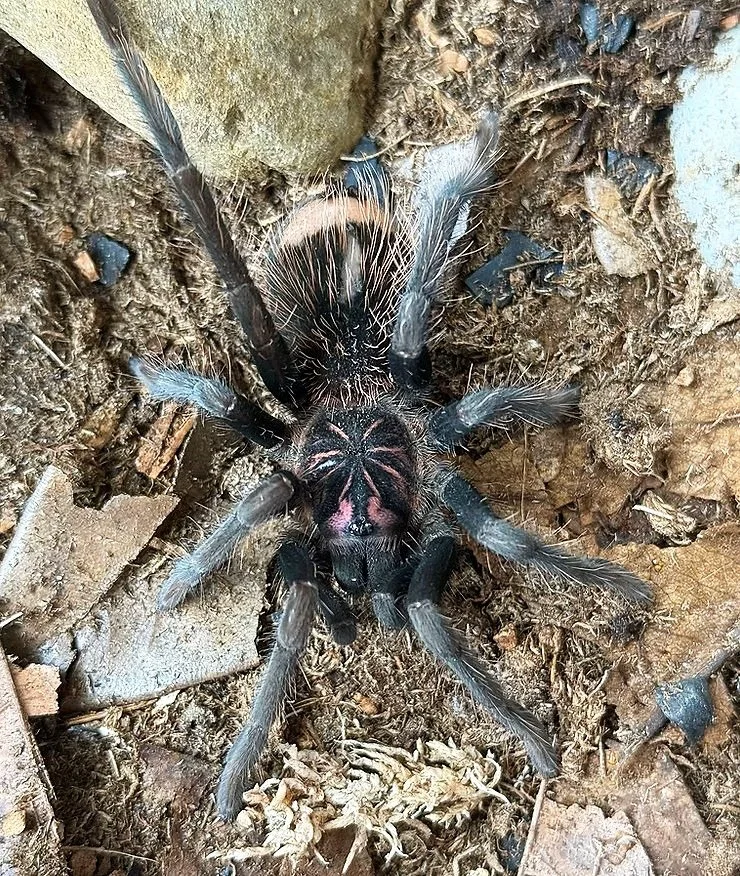
Xenesthis sp. ‘white’
Colombian Lesser White
Xenesthis sp. ‘white’ is an undescribed Colombian species in the genus Xenesthis Simon, 1891 (Theraphosidae: Theraphosinae), informally known in the hobby as the Colombian Lesser White. The genus currently holds five valid species (X. colombiana Simon, 1891 [type species, by original designation], X. immanis (Ausserer, 1875), X. intermedia Schiapelli & Gerschman, 1945, X. monstrosa Pocock, 1903, and X. avanzadora Sherwood, Gabriel, Peñaherrera-R., Brescovit & Lucas, 2023), all from Colombia and Venezuela (World Spider Catalog, 2026). Xenesthis are large terrestrial theraphosids diagnosed in part by a distinctive rose-to-carmine “starburst” pattern on the carapace — a feature expressed strongly in this undescribed form. The genus is also the subject of one of the better-documented spider–vertebrate commensalisms: X. immanis shares its burrow with the microhylid frog Chiasmocleis ventrimaculata, with feeding trials suggesting chemical defenses in the frog preventing predation by the spider (Cocroft & Hambler, 1989, Biotropica). As with all Theraphosinae, the genus bears type I urticating setae and uses them as a primary defense.