

Thrixopelma
Thrixopelma Schmidt, 1994 is a genus of small-to-medium New World terrestrial theraphosids in the subfamily Theraphosinae, endemic to the Andes of Peru and southern Ecuador. The genus was erected by Günter Schmidt on morphological features distinguishing its members from other Andean Theraphosinae — particularly spermathecal and tibial/leg structure — with Thrixopelma ockerti Schmidt, 1994 designated as the type species. It is a taxonomically active and recently overhauled genus: a series of revisions (Sherwood et al. 2021; Dupérré & Tapia 2025; Signorotto et al. 2025; Kaderka & Quispe-Colca 2025) redefined Thrixopelma narrowly and transferred most former members elsewhere. As of the World Spider Catalog (2026, Version 26.0), only four valid species remain: T. ockerti (central Peru; type), T. choquequirao Millenpeier et al., 2024 (Cusco, Peru, ~3,050 m), T. michaeli Dupérré & Tapia, 2025 (Zamora-Chinchipe, Ecuador), and T. supay Dupérré & Tapia, 2025 (Loja, Ecuador). Several names that older sources list under Thrixopelma are no longer in the genus: T. cyaneolum and T. pruriens (among others) now sit in Ewok; T. lagunas and T. longicolli (the name sometimes mis-cited as "T. longicornis") are in Warmiru; and T. nadineae is in Crypticarachne. Undescribed hobby locality tags continue to circulate — e.g. "sp. Cusco" / "Peruvian Royalty," and others such as "sp. Sullana," "sp. Loque," and "sp. Golden Blue" — and some likely represent undescribed species; however, given the recent reshuffling their generic placement is uncertain, and several may not belong to Thrixopelma in the strict modern sense.
Members of the genus occupy montane scrub, high-altitude grassland (puna), and lower montane/cloud forest, broadly from roughly 1,500 to 3,500 m (≈ 5,000–11,500 ft); T. choquequirao is documented near 3,050 m. (The exact type locality of T. ockerti is unrecorded — the genus was founded on captive-origin material — so its precise elevation is inferred.) They are semi-fossorial: juveniles dig modest, silk-lined burrows in compactable soil under rocks and bunchgrass, and adults often shift to larger retreats or rock crevices with a silk apron at the entrance. Seasonality is pronounced in the native range, with cool, dry winters and warmer, wetter summers, and captive animals respond well to a modest seasonal cycle. Compared with the lowland tropical Theraphosinae of the Amazon basin, Thrixopelma are notably cool-tolerant — unusual among New World terrestrials.
Coloration varies across the genus, though note that the spectacular cobalt-blue, red-rumped "Cobalt Red Rump" animal long associated with this name is cyaneolum, which is now placed in Ewok, not Thrixopelma. Among the species currently retained, T. ockerti shows deep velvet browns and coppery tones (hobby "flame rump"), and T. supay is described as grey-to-black with orange longitudinal stripes on the patellae and light joint banding. Adult females typically reach about 3.5–5 in (≈ 9–13 cm) diagonal leg span — small to medium by Theraphosinae standards — and are comparatively long-lived. Like other Theraphosinae, Thrixopelma bear urticating setae and kick hairs as a primary defense; the genus is characterized by type III setae (with type IV in at least some species) rather than type I. Venom effects are reported as mild and the animals are generally even-tempered, but handling any theraphosid is discouraged because it carries avoidable welfare and injury risk and offers the animal no benefit.
No Thrixopelma species is listed on CITES, and none has a published IUCN Red List assessment, although the genus's highland range is increasingly affected by road expansion, mining, and agricultural conversion. In captivity the genus does well with moderately deep substrate (4–6 in), a cork retreat or half-log, cool-temperate temperatures in the high-60s to mid-70s °F, and moderate humidity with strong ventilation — meaningfully different from the warm, humid protocols used for lowland Theraphosinae. Thrixopelma remains underappreciated in the hobby, valued for its color diversity, manageable size, calm disposition, and the practical advantage of suiting households kept cooler than a typical tarantula room.
Taxonomy per World Spider Catalog (2026), Version 26.0, Natural History Museum Bern, doi:10.24436/2. Key references: Schmidt 1994; Sherwood, Gabriel, Kaderka, Lucas & Brescovit 2021; Millenpeier, Chaparro, Ochoa, Ferretti & West 2024; Dupérré & Tapia 2025; Signorotto et al. 2025; Kaderka & Quispe-Colca 2025.
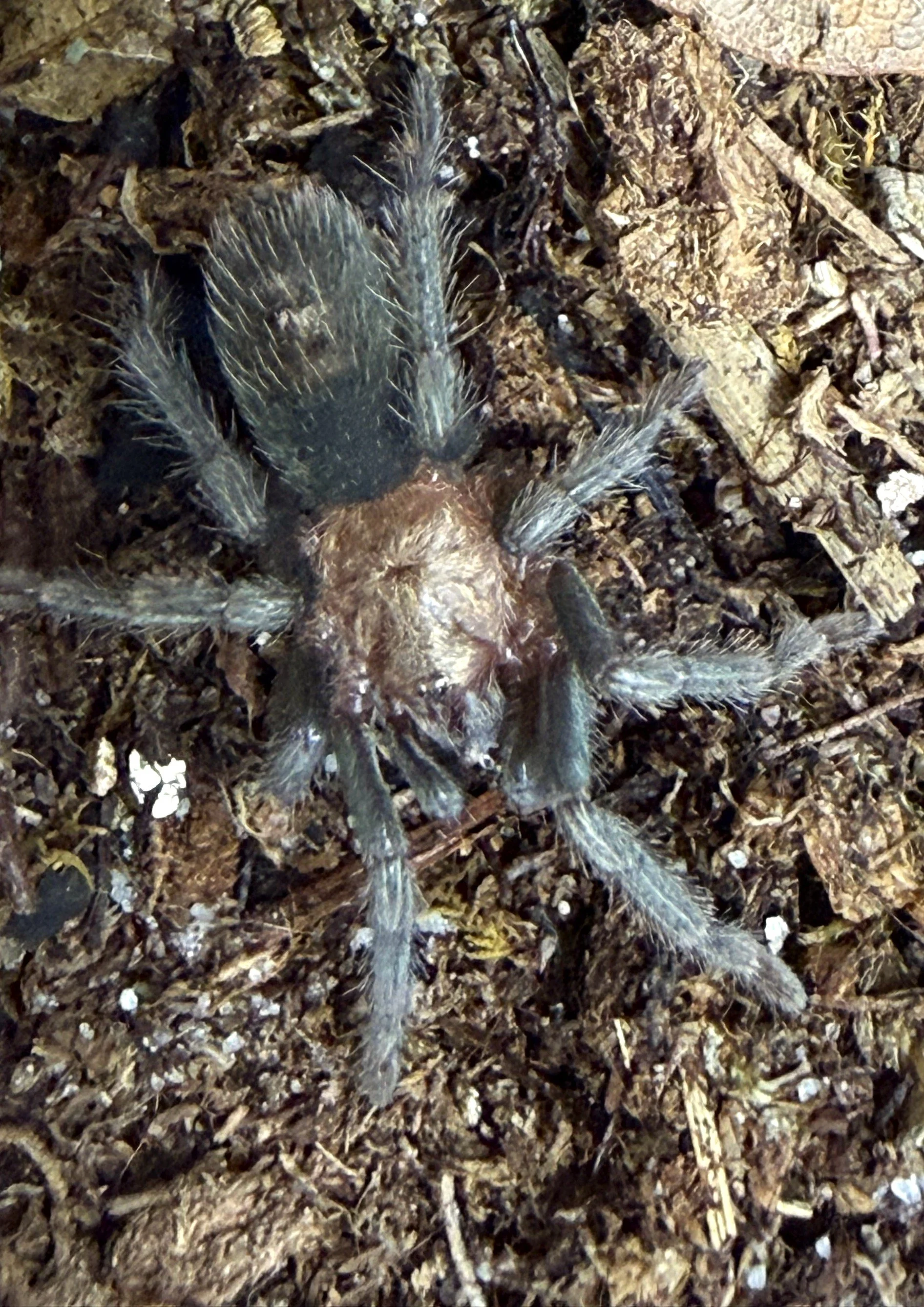
Thrixopelma sp. “Golden Blue”
Golden Blue
Thrixopelma sp. “Golden Blue” is an undescribed Peruvian trade form sourced from Andean highland material and currently treated as a candidate for formal description within Thrixopelma, pending integrative morphological and molecular work. The form is named for its dichromatic adult coloration: a warm golden carapace and abdominal pile contrasted with a cool metallic blue wash on the legs, most pronounced in subadults and freshly molted adults. The form is part of the broader wave of Peruvian highland Theraphosinae material that has entered the European and US hobby in recent years.