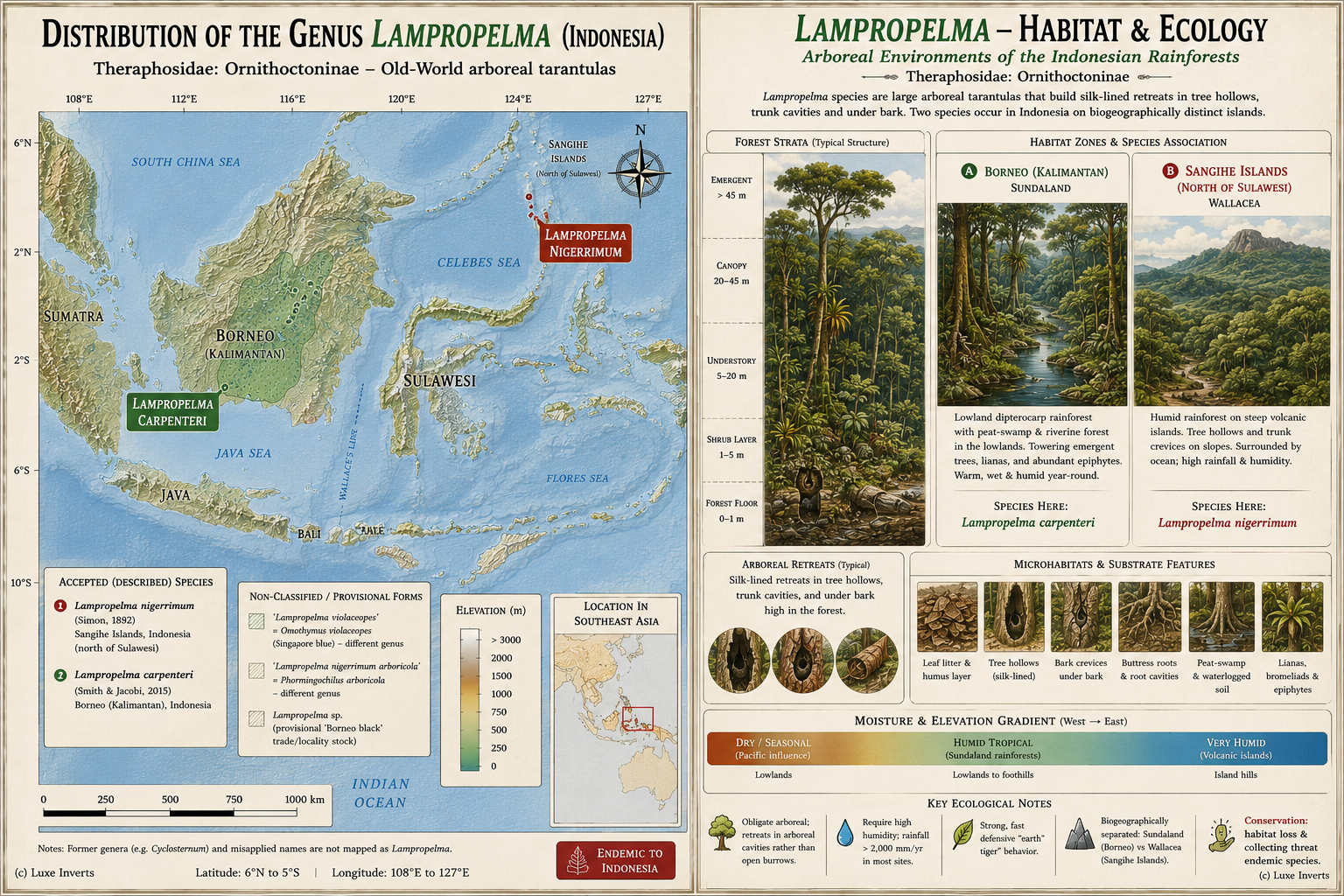

Lampropelma
Systematic placement and authorship. Lampropelma is an accepted genus of mygalomorph spiders in the family Theraphosidae (Thorell, 1869), subfamily Ornithoctoninae (Pocock, 1895). It was erected by Eugène Simon in 1892 in his Histoire naturelle des araignées (p. 151), with Lampropelma nigerrimum Simon, 1892 fixed as the type species by monotypy/original designation; the genus name is treated as neuter in gender. The World Spider Catalog (NMBE, Bern, 2026) currently recognizes exactly two valid species, L. nigerrimum and L. carpenteri (Smith & Jacobi, 2015).
Position within Ornithoctoninae. Lampropelma sits within the arboreal, primarily insular Southeast Asian radiation of Old World ("baboon/earth-tiger") theraphosids. It is one of three closely allied arboreal ornithoctonine genera — alongside Omothymus Thorell, 1891 and Phormingochilus Pocock, 1895 — that have historically been confused with one another and with the more terrestrial/fossorial genera Cyriopagopus and Haplopelma. The modern circumscription of all three arboreal genera rests on two papers: Smith & Jacobi's (2015) revision of Phormingochilus (Journal of the British Tarantula Society 30(3): 25–48), which first reorganized the group and described several species, and Gabriel & Sherwood's (2019) "revised taxonomic placement of some arboreal Ornithoctoninae" (Arachnology 18(2): 137–147, doi:10.13156/arac.2018.18.2.137), which is the action currently followed by the WSC.
Diagnosis. Gabriel & Sherwood (2019) diagnosed Lampropelma chiefly on male palpal-bulb morphology — specifically an apical swelling of the embolus that then narrows abruptly to a fine point at the apex — which distinguishes it from Omothymus and Phormingochilus. Because the three genera overlap morphologically, geographic provenance is used as a secondary discriminator; in the current concept Lampropelma is essentially an island-Southeast-Asian lineage. As with most ornithoctonines, the genus is otherwise characterized by the subfamily-level features (e.g., stridulatory and spermathecal/tibial-apophysis characters) that Gabriel & Sherwood used to stabilize the subfamily.
Taxonomic history and the 2015/2019 reshuffling. The modern two-species concept emerged by both adding and removing taxa: Lampropelma carpenteri was originally described as Phormingochilus carpenteri Smith & Jacobi, 2015 (female) and was transferred into Lampropelma by Gabriel & Sherwood (2019), who at the same time synonymized Phormingochilus kirki Smith & Jacobi, 2015 (described from a male) under it. So the species today carries one accepted name with kirki as a junior synonym. Lampropelma violaceopes Abraham, 1924 (the well-known "Singapore blue") was moved out of the genus to Omothymus. Smith & Jacobi (2015) first proposed this transfer; the WSC did not initially follow it as insufficiently justified, but adopted it once Gabriel & Sherwood (2019) formalized the move (WSC edit history dates the accepted transfer to August 2019). Lampropelma nigerrimum arboricola Schmidt & Barensteiner, 2015 — originally a subspecies of the type species — was raised to full species and transferred to Phormingochilus (as P. arboricola) by Gabriel & Sherwood (2019). Net result: two genuinely Lampropelma species remain, with the better-known "blue" and "arboricola" taxa now residing in sister genera. This is why older hobbyist and even some database references still list violaceopes and arboricola under Lampropelma.
The species. Lampropelma nigerrimum Simon, 1892 (type species). Original description based on a female (Simon, 1892); the male was later figured by Gabriel & Sherwood (2019: 143, fig. 17). WSC distribution: Indonesia — Sulawesi and the Sangihe Islands. It is the "Sangihe Island black," a uniformly jet-black arboreal species; popular and secondary sources note it was thought lost and was effectively rediscovered in the hobby/field around 2007, though that history is not part of the formal taxonomic literature and should be treated as anecdotal. Lampropelma carpenteri (Smith & Jacobi, 2015). Female described as Phormingochilus carpenteri; male as Phormingochilus kirki (now a synonym). Redescribed/figured under Lampropelma by Gabriel & Sherwood (2019: 144, fig. 18). WSC distribution: Malaysia (Borneo) and Indonesia (Sulawesi). The transfer was justified partly on comparative leg proportions and geography.
Distribution and natural-history context. As cataloged, Lampropelma has a narrow, insular Southeast Asian range concentrated on Sulawesi, the Sangihe Islands, and Borneo. Both species are arboreal, building silk-lined retreats in tree hollows and under bark in lowland and rainforest habitat — typical of the arboreal ornithoctonine guild — but formal ecological and life-history data are sparse, and most behavioral and longevity information circulating online derives from captive husbandry rather than peer-reviewed field study. In scientific terms the genus is best read as a geographically restricted arboreal ornithoctonine lineage resting on a small type series and a still-limited specimen base relative to better-sampled theraphosid genera, with its boundaries against Omothymus and Phormingochilus defined primarily by male palpal characters and provenance. A caveat worth flagging: the arboreal-ornithoctonine taxonomy has been unstable, much of the foundational work (Smith & Jacobi 2015; Gabriel & Sherwood 2019) was published in specialist/society journals rather than high-impact venues, and a molecular phylogeny rigorously testing the monophyly of Lampropelma and its separation from neighboring genera has not yet been published — so the current two-species concept is morphology- and catalog-based and may be revised as more material and DNA data accumulate.
Sources: WSC genus page — Lampropelma Simon, 1892; WSC — Omothymus violaceopes (transfer history); WSC — Omothymus Thorell, 1891; Gabriel, R. & Sherwood, D. (2019), Arachnology 18(2): 137–147, doi:10.13156/arac.2018.18.2.137; Smith, A.M. & Jacobi, M.A. (2015), J. Br. Tarantula Soc. 30(3): 25–48; Simon, E. (1892), Histoire naturelle des araignées, BHL; Wikipedia — Lampropelma; Tarantupedia — L. nigerrimum.