
Urupelma
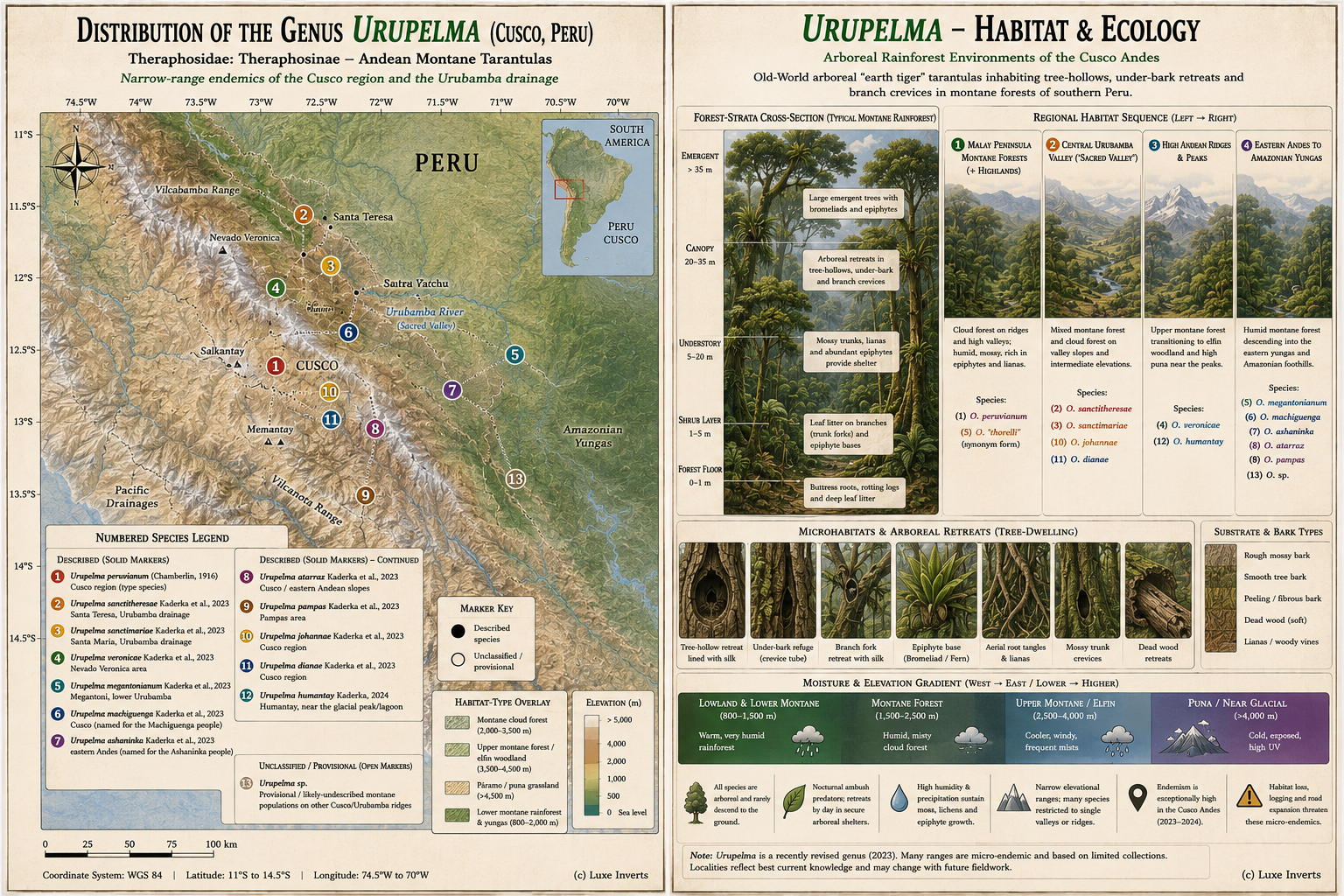
Urupelma Kaderka, Lüddecke, Řezáč, Řezáčová & Hüsser, 2023 is a genus of montane terrestrial theraphosids in the subfamily Theraphosinae, endemic to Peru. It was erected in a revision of the long-known Peruvian tarantula Homoeomma peruvianum (Chamberlin, 1916), published in the Journal of Natural History (57: 1710–1824; doi:10.1080/00222933.2023.2265621). The type species is Urupelma peruvianum (Chamberlin, 1916) — a species with a tangled history, originally described as Hemirrhagus peruvianus from material of the 1911 Yale Peruvian Expedition, later moved to Homoeomma, briefly placed in Isiboroa (Gabriel, Sherwood & Pérez-Miles, 2023), and finally designated type of Urupelma. Rather than holding only a few species, the genus is comparatively speciose for a recent erection: it was described with eleven new species, and as of the World Spider Catalog (2026, Version 26.0) twelve valid species are recognized (U. ashaninka, atarraz, dianae, humantay [Kaderka, 2024], johannae, machiguenga, megantonianum, pampas, peruvianum, sanctimariae, sanctitheresae, veronicae). Several species names reference localities in the eastern Andes of southern-central Peru (the Cusco region — e.g. Humantay, Verónica, Santa Teresa, Megantoni), reflecting a montane Andean and Andes–Amazon transitional distribution. Further species may yet be described, as the Peruvian montane theraphosid fauna remains incompletely surveyed.
Members of the genus are terrestrial inhabitants of montane Andean habitat, ranging from high grassland and rocky slopes down into humid montane/cloud forest. They construct silk-lined burrows and retreats among rocks and vegetation. The native environment is cool and strongly seasonal by Theraphosinae standards — substantial diurnal temperature swings, low annual means at elevation, and a pronounced wet/dry cycle — and the genus belongs to the cool- adapted montane radiation that Kaderka et al. (2023) examined explicitly in discussing the evolution of high-elevation tarantulas. (Note: the highest altitude record for the family belongs to the related Peruvian genus Antikuna Kaderka et al., 2021, not to Urupelma.)
Morphologically, Urupelma are small-to-medium Theraphosinae; precise size, coloration, and setal data are given species-by-species in the original revision rather than summarized here, so broad claims (e.g. a uniform "dwarf" size or a single dominant color scheme) should be treated cautiously. Like other Theraphosinae the genus bears abdominal urticating setae and kicks them as a primary defense; the specific setal-type complement is detailed in Kaderka et al. (2023) and should be cited from there rather than assumed to be "type I." Venom is presumed mild, as in related Andean Theraphosinae, but documented envenomation data for this newly described genus are essentially absent.
No Urupelma species is listed on CITES, and none has a published IUCN Red List assessment; the genus was described only in 2023. Its montane Peruvian range is nonetheless subject to pressure from mining, grazing, and climate-driven shifts in montane habitat. Because the genus is newly erected and effectively absent from the pet trade, established captive-husbandry protocols do not exist; any keeping recommendations are inferences from its cool, seasonal, montane native conditions (cool-temperate temperatures, good ventilation, a substrate that is neither waterlogged nor bone-dry) rather than documented practice. Urupelma is best understood as a scientifically significant montane lineage — part of a recent wave of Andean theraphosid discovery — rather than as a hobby animal.
Taxonomy and distribution per World Spider Catalog (2026), Version 26.0, Natural History Museum Bern, doi:10.24436/2. Primary references: Chamberlin 1916; Pérez- Miles & Locht 2003; Gabriel, Sherwood & Pérez-Miles 2023; Kaderka, Lüddecke, Řezáč, Řezáčová & Hüsser 2023; Kaderka 2024.