

Acanthoscurria
Acanthoscurria Ausserer, 1871 is a genus of large, heavy-bodied terrestrial theraphosids in the subfamily Theraphosinae and one of the most conspicuous New World tarantula lineages. The type species is Acanthoscurria geniculata (C. L. Koch, 1841) — the Brazilian Giant White-Knee, originally described as Mygale geniculata — designated by monotypy, and the genus is now known from Argentina, Bolivia, Brazil, Colombia, Ecuador, French Guiana, Guyana, Paraguay, Peru, Suriname, and Venezuela, with a documented presence in the Windward Islands of the West Indies. After a long period of taxonomic sprawl — the genus at one point accommodated well over thirty nominal species — a sustained wave of revisionary work has pulled the count down to roughly nineteen valid species (World Spider Catalog, 2026). The most consequential recent papers are Fukushima and Bertani's 2023 cladistic revision of Lasiodora (Zootaxa 5390), which resolved a tangle of shared species between Acanthoscurria, Lasiodora, Crypsidromus, and Proshapalopus and transferred L. sternalis into Acanthoscurria as A. melloleitaoi (to avoid homonymy with A. sternalis Pocock, 1903), and Sherwood, Gabriel, Peñaherrera-R., and García's 2025 treatment (Zootaxa 5563) proposing the theraphosoides species-group and describing A. armasi sp. nov. as the first published record of the genus from Colombia.
The genus occupies an unusually broad slice of the Neotropics. Northern Amazonian species (A. geniculata, A. theraphosoides, A. juruenicola, A. armasi) are animals of primary and secondary lowland rainforest on the Guiana Shield and the Brazilian Amazon; central-Brazilian species (A. gomesiana, A. natalensis) extend across Cerrado savanna and the Caatinga xeric scrub of the Northeast; southern species (A. insubtilis, A. chacoana, A. cursor, A. suina) occur through the Chaco and the subtropical Atlantic Forest as far south as Argentina and Uruguay; and the West Indian records extend the genus onto the Windward Islands. This habitat breadth is reflected in captive husbandry, where the A. geniculata profile that dominates the hobby (warm, moderately humid, Amazonian) is a poor template for the drier Cerrado and Chaco species.
Members of the genus are terrestrial with opportunistic, rather than obligate, burrowing. Juveniles excavate shallow silk-lined retreats under cover; sub-adults often expand these into a proper burrow; mature females tenant a cork retreat or a wall-backed scrape and are visible on the surface far more frequently than the reclusive Neotropical burrowers (Theraphosa, Xenesthis, Pamphobeteus). Acanthoscurria sits in Group A of the Theraphosinae defined by Perafán et al. (2016, updated in Foelix, Erb, Rast, and Peretti, 2019, PLOS One 14(11)) and bears type I urticating setae as its principal defensive armament; the genus is notorious in the hobby for how readily it deploys them, and A. geniculata in particular is among the most enthusiastic hair-kickers in the family. Venom is mild — documented bites have produced only transient localized effects — and defensive behavior combines the urticating-hair kick, a rapid retreat into the burrow, and, if pressed, a high threat display with bite attempted only when cornered. Coloration is variable across the genus: the iconic black-and-white tarsal-and-metatarsal banding of A. geniculata is shared by several congeners, while other species (A. chacoana, A. juruenicola) are uniformly dark or olive, and yet others (A. natalensis) carry pale carapace pubescence over a darker ground. Females across the genus reach 6–8 in diagonal leg span at maturity — A. geniculata and A. juruenicola sit at the upper end — with stout, heavily-built opisthosomas that reflect the genus's general habit of growing quickly, moulting often, and eating prodigiously.
No Acanthoscurria species is currently listed on CITES, and none has a published IUCN Red List assessment at the species level, though several species — particularly A. geniculata and A. insubtilis — have been subject to sustained collection pressure for the international pet trade, and ongoing loss of Cerrado and Atlantic Forest habitat is the meaningful conservation concern across much of the genus's range. In captivity, the genus expects 4–6 in of moderately moist substrate with a dry surface, a cork retreat at ground level, mid-70s to low-80s °F for Amazonian species and a few degrees cooler with lower humidity for Cerrado and Chaco species, and generous cross-ventilation in all cases. Acanthoscurria is not a beginner genus despite its ubiquity in the hobby — the size, speed, and particularly the urticating-setae output of mature females are substantial — but it is among the most rewarding terrestrial genera for keepers ready for a large, active, hard-eating theraphosid and one of the more active areas of current systematic work in the subfamily.
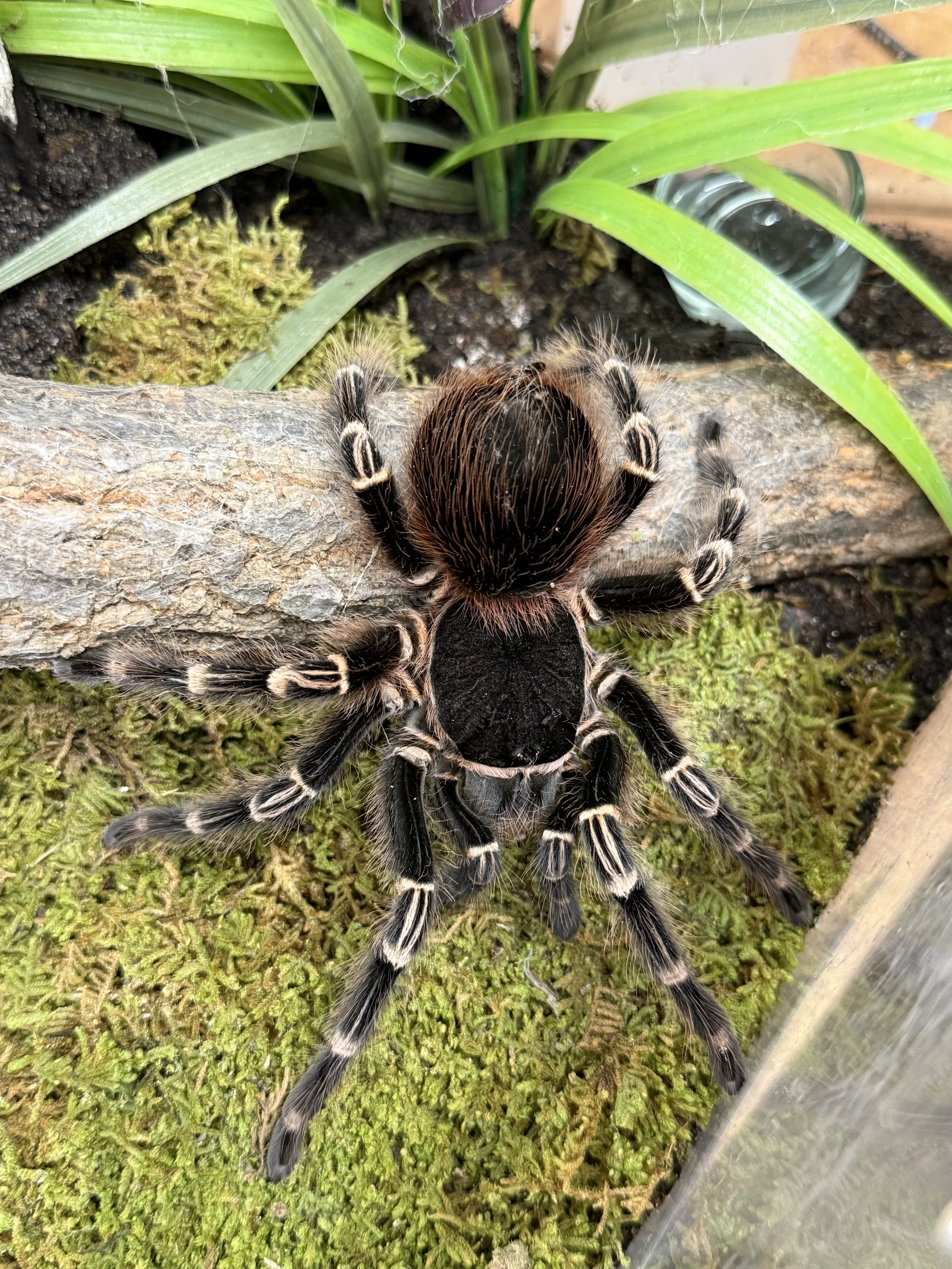
Acanthoscurria geniculata
Brazilian Giant White-Knee
Acanthoscurria geniculata (C. L. Koch, 1841) is the Brazilian Giant White-Knee and the type species of Acanthoscurria Ausserer, 1871 (Theraphosidae: Theraphosinae). It was originally described as Mygale geniculata from Brazilian Amazonian material and remains the most familiar and widely-kept species in a genus whose current valid species count stands at roughly nineteen following sustained recent revisionary work (World Spider Catalog, 2026). The species is a northern Amazonian lowland rainforest inhabitant and, along with congeners such as A. juruenicola, sits at the upper end of the genus in size. Acanthoscurria belongs to Group A of the Theraphosinae (Foelix, Erb, Rast & Peretti, 2019, PLOS One 14(11)) and bears type I urticating setae as its principal defensive armament; A. geniculata in particular is notorious for the readiness with which it deploys them.
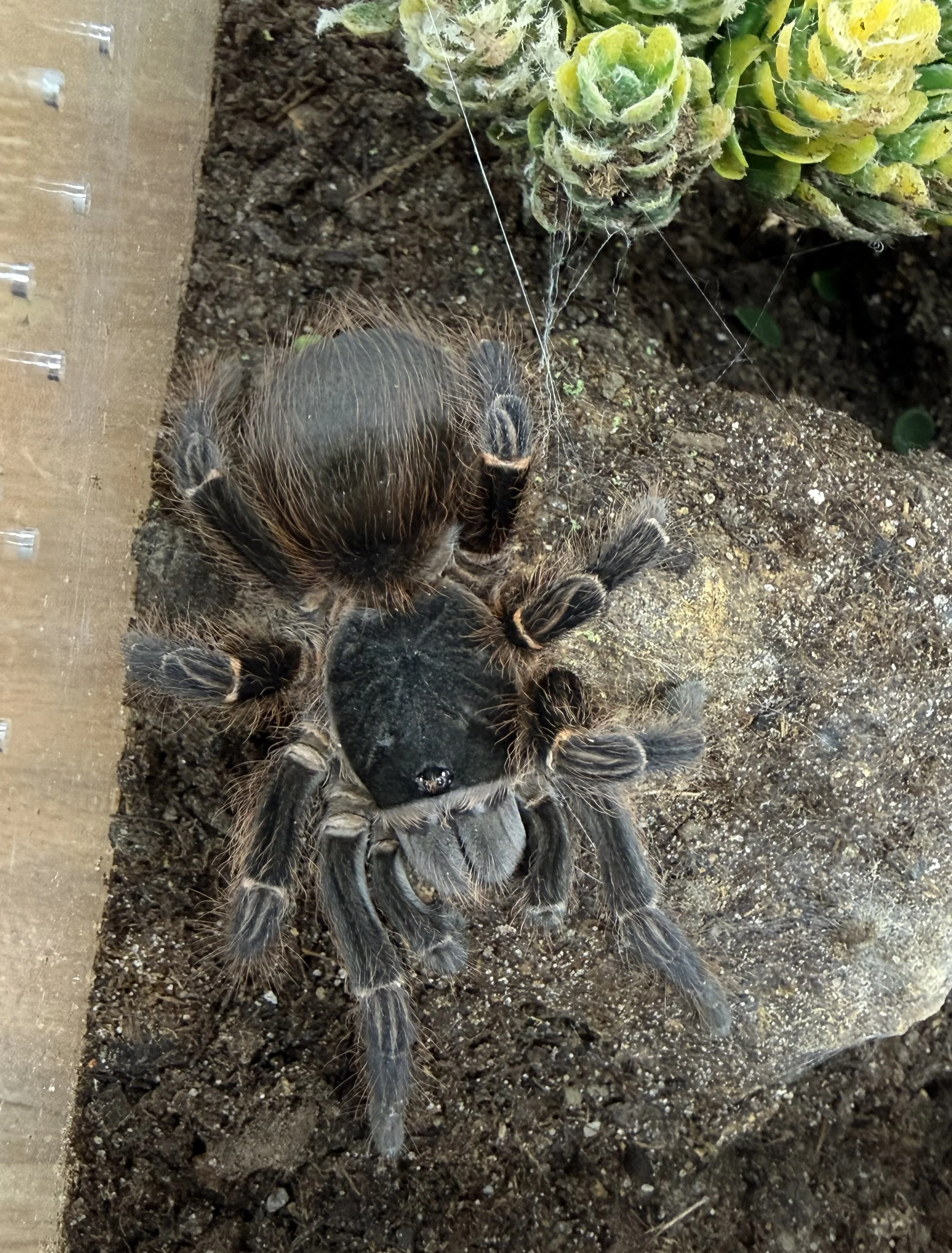
Acanthoscurria sp. ‘Maldonadoensis’
Maldonado Birdeater (hobby form)
Acanthoscurria sp. ‘Maldonadoensis’ is an undescribed hobby form sold under a Latinized manuscript-style name that evokes Maldonado Department in southeastern Uruguay; the epithet is, however, misleading. The animals circulating in the international pet trade under this name trace not to Uruguay but to commercial collection in the western Amazon — most reliably the Madre de Dios region of southeastern Peru — and their coloration, temperament, and size fit comfortably within the northern Amazonian Acanthoscurria radiation (A. theraphosoides, A. juruenicola, A. geniculata), not the smaller Southern Cone species known from Uruguay (A. suina, A. chacoana). The name is not recognized in the World Spider Catalog (2026) and has not been formally published; the form is not listed as nomen dubium or as a junior synonym, and it should be treated as awaiting formal description. The genus Acanthoscurria Ausserer, 1871 itself remains an active area of systematic work — Fukushima & Bertani, 2023 (Zootaxa 5390) and Sherwood et al., 2025 (Zootaxa 5563) have both moved material in and around the genus — and it is plausible this form will receive placement in a future revision.
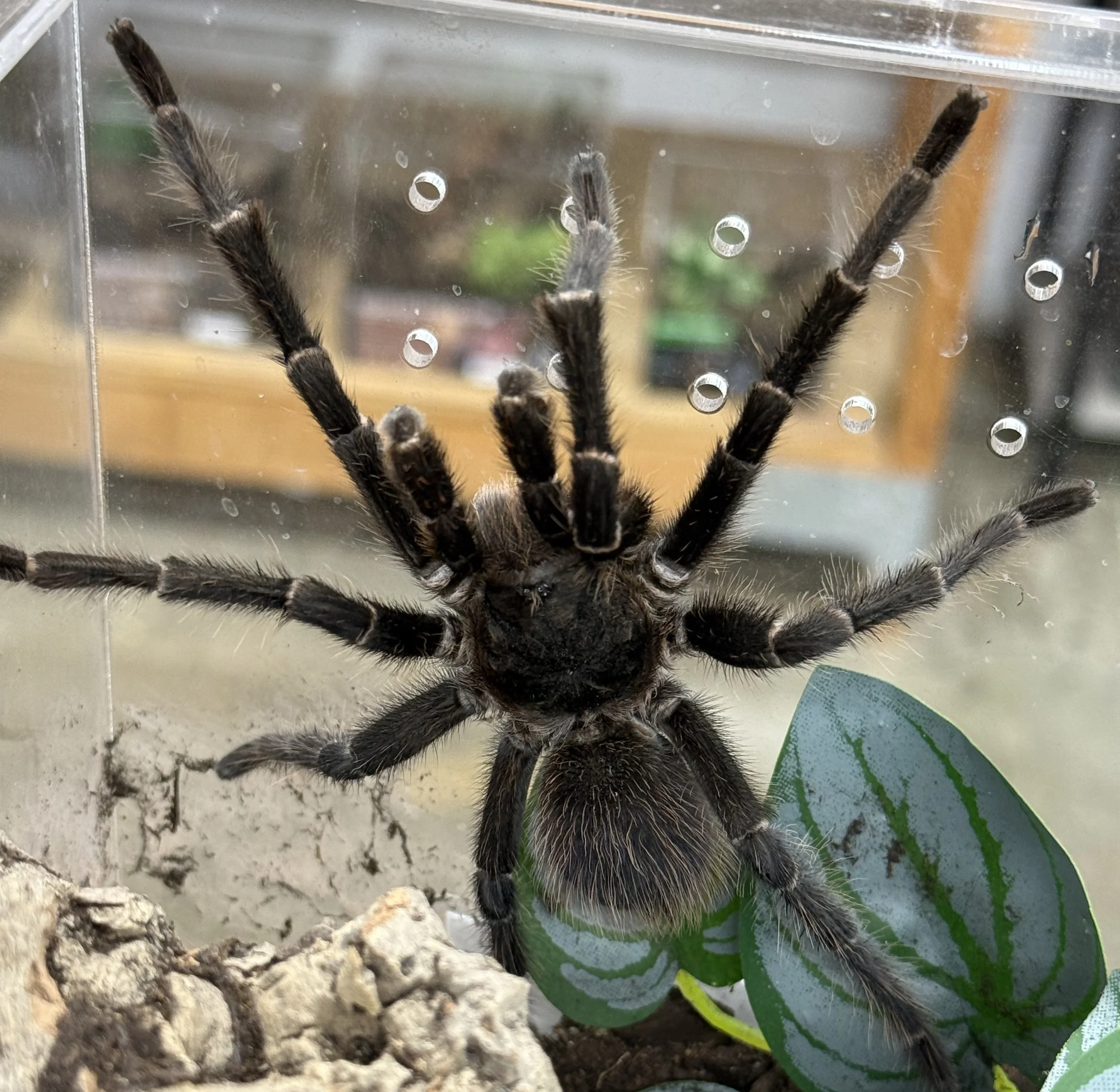
Acanthoscurria sternalis
Argentine Giant Black Rump
Acanthoscurria sternalis Pocock, 1903 is the principal Argentine Acanthoscurria, distributed widely through the Chaco and Pampa biomes from northern Argentina north into Paraguay, Bolivia, and the Brazilian state of Mato Grosso do Sul. The species is diagnosed in part by an unusually dark, almost glossy black opisthosoma in adult females — the basis for the “Black Rump” trade name — contrasting with the chocolate-brown carapace and the reddish-orange opisthosomal setae characteristic of the genus. The taxonomy of southern Acanthoscurria has seen substantial recent attention (Ferretti et al., 2011, Zootaxa 2828), and several pre-1990 nominal taxa have been rearranged under or near A. sternalis in the resulting synonymies.